Hi, I'm Jasmine and this is my A2 Media Studies Blog, anything found here is my own creative genius...unless stated otherwise. So read and enjoy! :)


Friday, 8 July 2011

Genre Analysis of Katy Perry's Last Friday Night

—Genre as applied to Katy Perry’s Last Friday Night is quite self-explanatory. Genre in itself is a historical concept which has been utilised since the ancient Greeks “Greek literature was divided into well-defined literary genres” http://en.wikipedia.org/wiki/Ancient_Greek_literature.
—However Genre has evolved substantially since then and now depends on the various media it applies to. In Pop Music Videos  Intertextuality is well-used and Katy Perry's music video is no different as it makes reference to Rebecca Black’s song Friday and the commonly used phrase ‘TGIF’
 —Katy Perry is a Pop singer; therefore the Genre of this music video is also Pop. The Pop page on Wikipedia says that “‘pop music’ may be used to describe a distinct genre, aimed at a youth market, often characterized as a softer alternative to rock and roll”. This is true of the Music video as the classic American-teen house party stereotype is fulfilled strongly throughout this video. Almost all the characters within this video are teenagers apart from Katy’s parent and her ‘uncle’ Kenny.
 —Goodwin’s theory on Music Video Genre is also satisfied on more than one point. Firstly there is a correlation between the screen visuals, the music and the lyrics and this makes the song very straightforward, applicable to teenagers/young people (the target audience) and therefore easy to understand unlike Indie or Rock bands which focus entirely on performance and have hidden ‘deep’ meanings within their songs.
—Secondly, the colours theme and concept of the music video are highly relatable to the pop genre as it always centers on young people having a good time partying or going out and meeting other young people. Voyeuristic treatment of the female body is openly explicit as a part of society’s ideology in this video as the ‘jock’ squeezes Kathy’s bum. Close-ups of the female body are very explicit as it has become a well-known part of Musical genre.

Wednesday, 29 June 2011

Analysis of a Music Video using Key Terminolgy


The Music video Last Friday Night (T.G.I.F) by Katy Perry utilises, Flashbacks, Dream sequences and Different POVs in order to fully convey the complications of teenage relationships. The Music video has a clip before and after the actual music video in order to provide insight/context to the video's narrative/story. The narrative itself is told in a retrospective manner, similar to an Episodic narrative, as the main character 'Kathy' re-lives the events of the previous night.

Katy’s character is the stereotypical geek who goes through an amazing makeover allowing her to gain the attention of her ‘Jock super-crush’, thus following elements of an American teen-romance, this establishes the Disequilibrium. The 'Geeky' boy is in love with Katy and at the end of the narrative, as is the typical cliché; he turns out to be the better option for her hence the restoration of a new equilibrium, in the ending clip, much similar to the first.

The Dream sequences are told from his POV with the costumes emphasising their positions for comedic effect, whereas the rest of the video is told from Katy’s perspective.  The memorable and well-known American teen party-next-door atmosphere is satisfied in the form of Rebecca Black who takes on the role of the ‘popular girl’ who using Propp’s Character theory serves as the Donor, Helper and the Dispatcher. However in reference to Goffman's character theory she would be named more appropriately as a 'Deuteragonist' (secondary character).

The constant Media references within the video work as forms of Intertextuality; Black’s song 'Friday' has been named one of the worst songs and the term T.G.I.F is a world-renowned phrase/abbreviation for 'Thank God Its Friday'. The Music Video will serve as a means to raise awareness of both artists, as well as boost the sales of their music individually.

Tuesday, 28 June 2011

Reorganisation/Re-naming of Posts

Alot of changes have been made to my blog recently, so if you're wondering what's going on then I think this should explain it :) I have managed to categorise each post by the labels so if you want to find something its there on the right-handside>>>
Next I have changed the names of some of my posts because I have added more things which no longer make the title relevant. That's about it but if there are any problems concerning where posts are let me know and I'll let you know :)

Sunday, 26 June 2011

Analysis of my AS Coursework...

Digital Technology

"A branch of knowledge which deals with and leads to the possible use of any electronic devices that can be used to undertake tasks such as recording a film, editing film, taking photos or playing music"
In application to my AS Media Coursework Digital technology for me, was the use of various cameras and software which allowed me to complete my coursework. To begin with, I used a SLR Camera with studio lighting to increase the quality of my images. These were then edited on Adobe Photoshop. Next I used an Autocue and Greenscreen in the production of my Planning Documentary this was edited and produced in Adobe Premier and Aftereffects. I also burned my coursework onto a DVD with the help of Adobe Encore.

Research and planning
 This is the stage used to gather information on your chosen topic of research. The planning stage is used to help you organise thoughts and ideas into a manageable format thus allowing you to utilise them in a sensible and effective manner.
My research and planning stage for my coursework is quite detailed and this helped me to keep ahead of the ‘curfews’ I had set myself. I followed the styles and genre of articles favoured by music magazines I wished to emanate. For example I looked especially at the American music magazine Billboard. Billboard I found was the most long lasting and most successful music magazine in America (over 100 years old). It covered all genres of music and this was what I wanted my magazine to be like. The more research I did the more I could apply to my coursework to make it look life-like and professional.

Skills Development:
The improvement or increase of one’s personal skills or achievements.In my AS Coursework I made a huge jump in my skills development as my skills at GCSE were still very basic. At the beginning of our AS project we made our preliminary tasks and in this my basic skills are clearly displayed. My final coursework conveys how my technical abilities improved e.g I can now produce and edit a video using premier and after effects.
Creativity
Creativity is a mental process involving the discovery of new ideas or concepts, or new associations of the existing ideas or concepts, fuelled by the process of either conscious or unconscious insight. http://en.wikipedia.org/wiki/Creativity
For my preliminary task I displayed creative ability through my front cover. I took a photograph of myself reflected in a mirror. I had a feeling that the photographic results would in fact be quite good, as Frank Capra once said ‘A hunch is creativity trying to tell you something.’  This befitted the main article as it fit in with the context of the article as well as the main protagonist.
This definition is true of my creative process in creating my AS Media Coursework as I used my own ideas as well as existing ideas to help me form the basis of my magazine. For example I may have thought of the colour scheme, model and the props and costumes I used in my magazine but I would have been influenced by unconsciously through my knowledge of semiotics. I also used my conscious insight to use ideas from other magazines and their articles which were similar to the magazine I wished to emanate.
Intertextuality
In a text, implied references to or implied influences from another text. This concept allows a reader to make links between genres, and to see how themes, plot, etc. may develop or change in relation or in light of that other text. http://people.virginia.edu/~jrw3k/Front%20Pages/Critical%20Vocabulary.htm
Intertextuality has, as critic William Irwin says, “Come to have almost as many meanings as users, from those faithful to Kristeva’s original vision to those who simply use it as a stylish way of talking about allusion and influence”. The term is relatively new and was first coined by Julia Kristeva in 1966, it was an attempt made by her to combine the study of semiotics (signs and symbols) with dialogism (study of multiple meanings in texts and words).
In my AS Coursework I used Intertextuality by referencing different artists, eras and genres of music. This was important as my coursework was made to emanate the experience of a music magazine; with magazines being perhaps one of the most popular form of Intertextuality. It references beauty products, current events, as well as social events, physical and cyber, such as facebook, myspace, music festivals and music concerts.


My AS Media Magazine Coursework

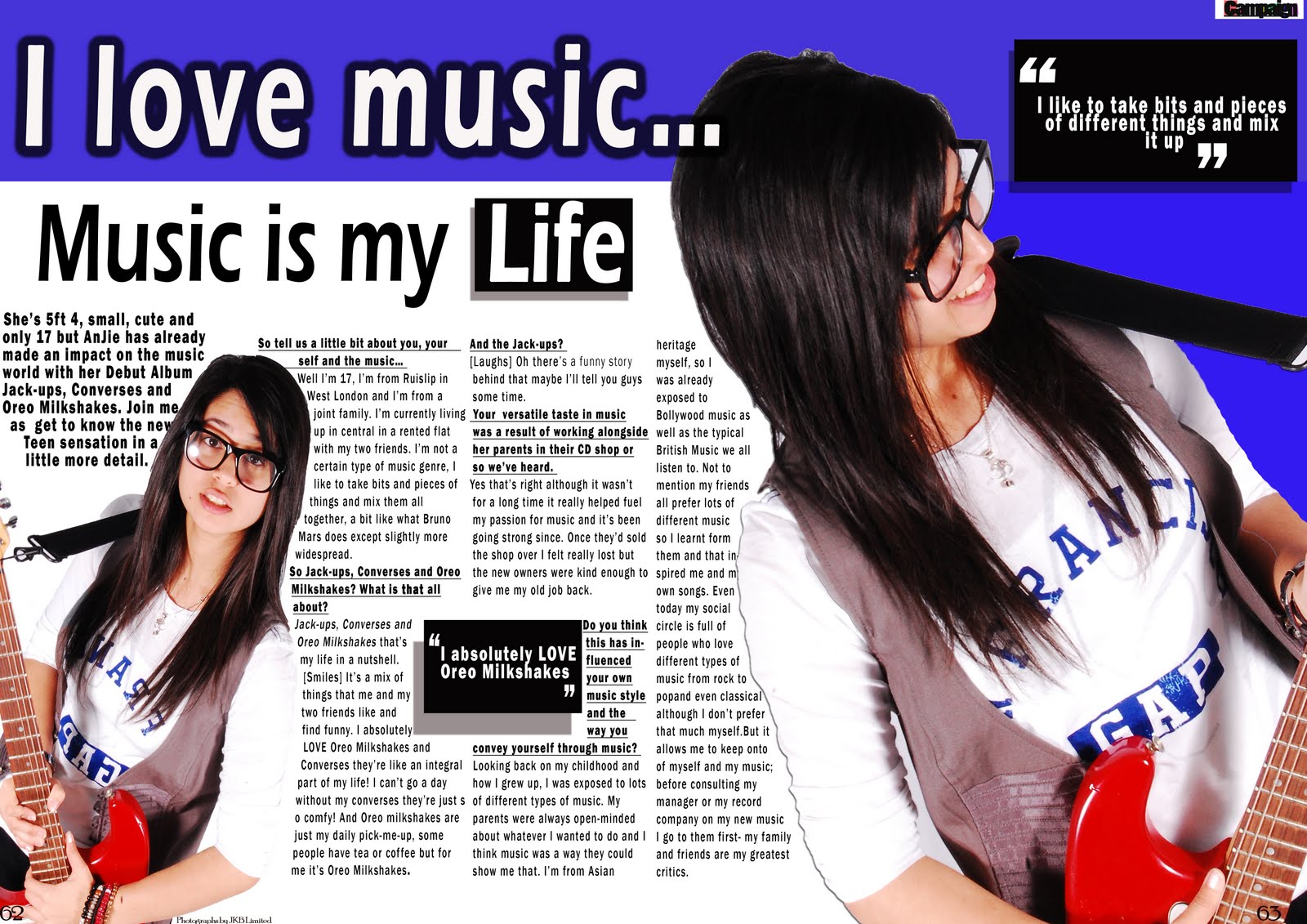
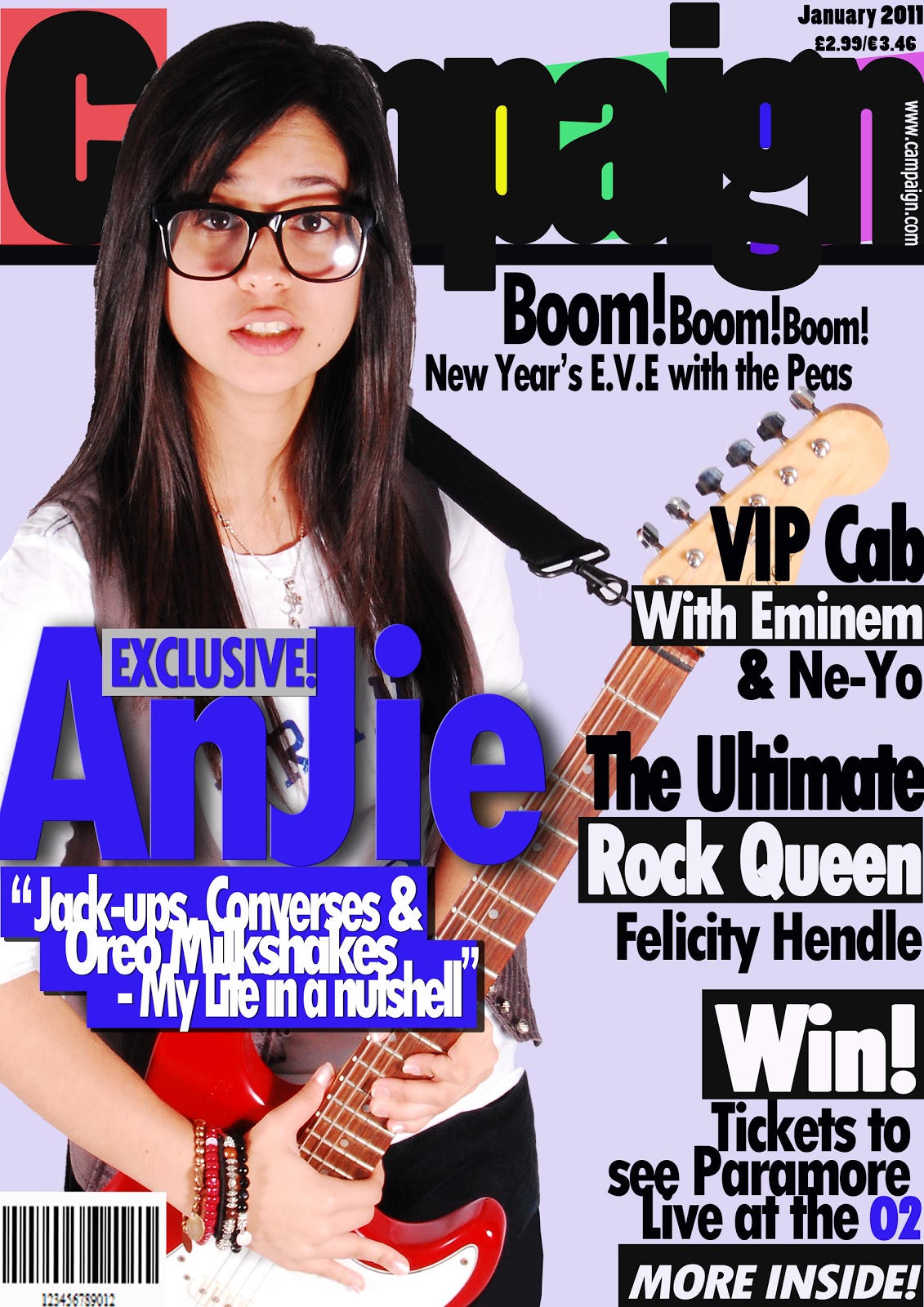
 Here are the images of my AS Coursework which i produced in relation to Music Magazines. I created a Front Cover, Contents page and two Double Page Spreads. All of the images were taken and edited by myself with the very much appreciated help of my teachers :)


Music Magazine Front Cover
Name of magazine: Campaign

Music Magazine Contents Page


Opening Double Page Spread (1)

Main Double Page Spread

Ideology is...

"The ideas and manner of thinking characteristic of a group, social class, or individual."

http://www.google.co.uk/#hl=en&q=ideology&tbs=dfn:1&tbo=u&sa=X&ei=rPgHTt_lFMyz8QO5mLWLAg&sqi=2&ved=0CBwQkQ4&bav=on.2,or.r_gc.r_pw.&fp=a8a55e593a51cf94&biw=1072&bih=479

The ideals or thoughts of an individual, or even a whole society, are collectively known as the Ideologies it holds. These thoughts hold a great influence in the way a society functions everyday, for example within the Western society many people believe in sex before marriage and this is duly portrayed through the media in the form of Books, Magazines, Music videos, TV programmes and Film. In the Eastern society they do not follow the same Ideology therefore, the Media Industry must take this into account when creating a media product for them.

Narrative is...